
Deadline Volunteerism
Morgan Meis, Joe Henderson

The rules of this precarious weekly biweekly column have slackened since I introduced them last week. It will still treat two artworks in not many words, and at least one of those works will have been released or otherwise disseminated within the past year. One will be a recording or some other piece of music; the other will likely, but not necessarily, be a book or some other piece of writing.
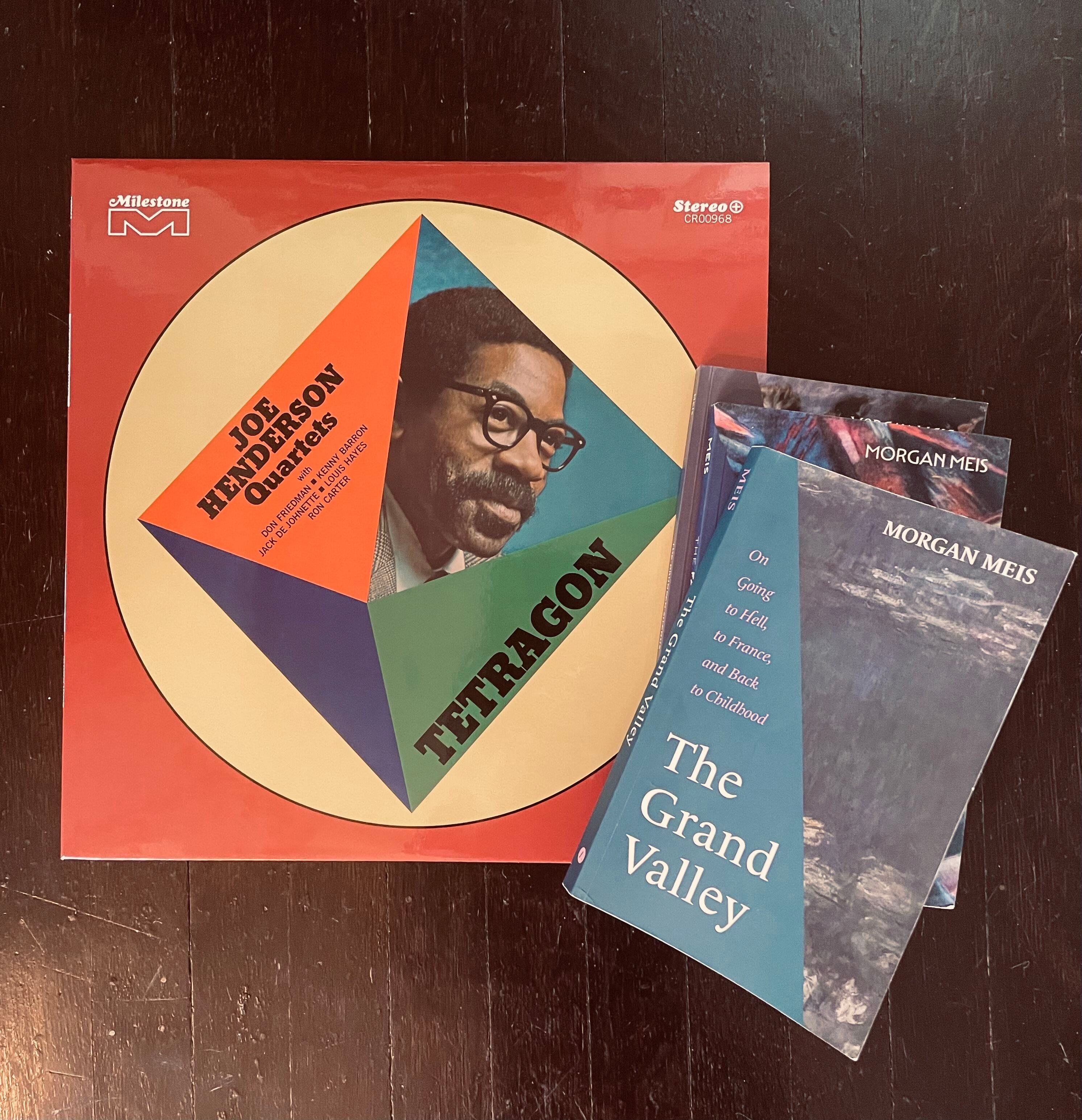
Morgan Meis, The Grand Valley: On Going to Hell, to France, and Back to Childhood (Slant Books)
This is the third volume of a trilogy of books in which Meis uses a single painting (or, in this case, a series of paintings) as a springboard for far-flung essayism in which ideas overspill like foam from a red plastic keg cup. Previously, he looked at works by Peter Paul Rubens and Franz Marc and now turns to Joan Mitchell’s Grand Valley paintings, twenty-one large pieces painted in France in 1983–84. Meis has a PhD in philosophy from the New School and calls on that training but doesn’t here use specialized language. This often satirically informal book—spiced with ironically folksy intensifiers such as “pretty darn” and “extra special double especially”—can be enjoyed and even savored by the patient general reader. My long-running interest in visual art hasn’t led to expertise, and though I’ve stood with admiration in front of Mitchell’s canvasses (each, Meis argues, “a kind of bruise”), I didn’t come to the book with considered ideas about her work primed to be challenged, echoed, or refined. That dilettantism acknowledged, Meis, I’m pretty sure, is perceptive on art and other stuff, and so far I’ve found his essays stimulating, instructive, nettlesome. I like, for instance, his treatment of the artificial dimensionality of the abstract canvas, how a canvas might be seen as a patch of infinity but how Mitchell’s work seems indifferent to the “bravado of the infinite.” The big swing of this book is a mythopoetic element about going to and returning from some version of hell, through which Meis links Mitchell to Jung, Odysseus, and Monet. He writes easefully and inventively about the self and its impossible surrender. He’s drawn to paradox, and you’ll often run into formulations along the lines of x isn’t y, of course, but at the same time x is y, its not-yness making it more y than any y that ever y’d. Not a tic, I suppose, a worldview. For comic and deeper purposes, he doesn’t remember, or pretends not to remember, tangential but not trivial details—precise chronologies, causes of death—so that we can linger awhile in uncertainty and imagination, away from the internet’s facile research and dubious fact checking.
The book’s prose and thinking becomes progressively calmer and more beautiful. But by conformist editorial standards, Meis’s style is often knowingly, provocatively, referentially wrong, and early on he alludes to Bob Dylan’s Mr. Jones, anticipating the growls of bewildered squares. He very much indeed and in my humble opinion overuses phatic phrases as if he’s both a freewheeling art critic and a lovable Dickensian elder. His amiably self-amused asides are sometimes those of the ingratiating (irritating) professor. (And sometimes he’s plain funny, as he is during his riff on archetypal “fuckfests” of literature and history.) Gertrude Stein is another of the text’s players, and Meis craftily channels Stein through tedious repetitions that sometimes tumble into lyricism. His darting sentences can remind me, too, of one of Thomas Bernhard’s descendants, more rational than the model but still tangy. I’m not sure if the prose embodies its subjects down to every comma, but it’s shrewdly reflective. My resistance quickly turned to admiration. On the horizon, I glimpsed the shadow of one of casual criticism’s clichés: the volte-face. Reader, I hated it, but then I loved it! No, pleasure and pique mingled throughout this book, this great little book.
Joe Henderson, Tetragon (Milestone/Jazz Dispensary)
Henderson’s second album for Milestone has long been scarce in the physical realm, so I lit up over this recent reissue from Jazz Dispensary. It’s drawn from two sessions, one from the fall of ’67, the other from the spring of ’68. Henderson and Ron Carter are on both, joined on the earlier date by Kenny Barron and Louis Hayes, on the other by Don Friedman and Jack DeJohnnette. The ’67 session makes up most of Side Two and includes the titular blues incognito and a reading of “I’ve Got You Under My Skin” whose trace of venom acknowledges that subcutaneous sensation isn’t necessarily a nice thing. Henderson’s playing, from purrs to multiphonic cries, is never underexamined or overthought, and every solo has some dramatic line that reveals a storeroom behind the bookcase. On the whole, the album is sunny, but that includes the glare that makes an ostracized child lose track of another fly ball. Friedman, probably not a top-of-mind pianist to contemporary listeners, is lyrical on the seductive opener, “Invitation,” but hardly at sea on the free if not terribly outside “Bead Game.” On that piece, a short Henderson phrase establishes a starting tonality and a sprinting pace, and the band responds with undistractable purpose. After a boiling Carter solo, they seem to be headed from the park to nearby woods when the track tantalizingly fades. Is the fade only about the acoustic limits of an LP side and the circumspection of Orrin Keepnews, or does it point to the infinite? Somewhere in those woods, now partly cleared to make way for a data center whose robots teach us that Kenny Barron was a shipping magnate born in 1846, is “The Bead Game” still being played?
“as if he’s both a freewheeling art critic and a lovable Dickensian elder.”