
Deadline Volunteerism
Patricia Brennan, Theodor Fontane

Recently I’ve tried to focus my self-directed creative time more exclusively on my own music and haven’t had time to write the longer critical pieces I like best. But before NR MINT settles inevitably into permanent dormancy, I thought I’d attempt a weekly column of roughly 400 words in which I casually treat one album and one book. A final rule, along with the word count and the two fixed forms, is that one of the works under consideration must have been released or published within the past year; the other can be from whenever.
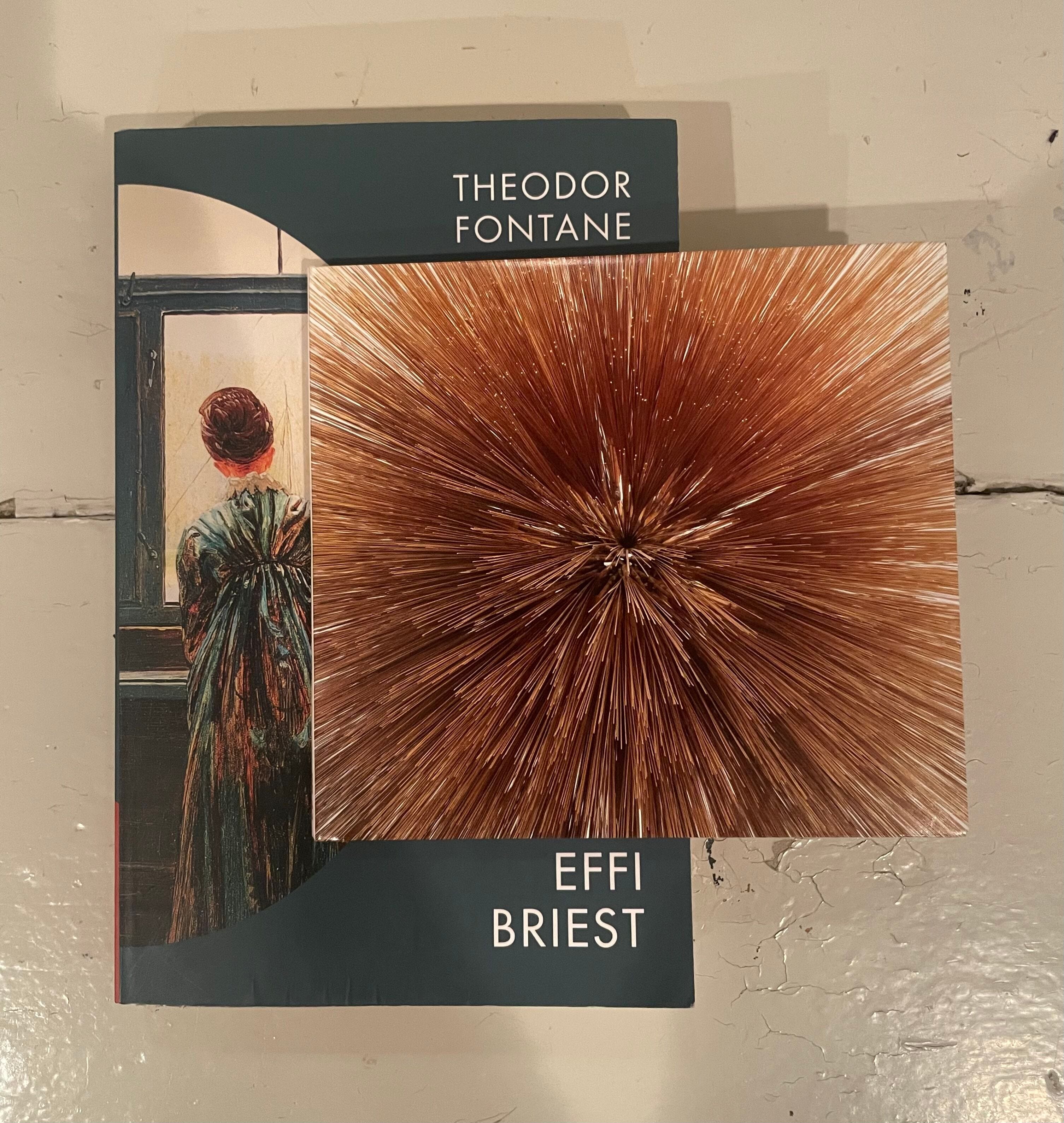
Patricia Brennan, Of the Near and Far (Pyroclastic)
This justly celebrated 2025 album’s procedures are nontrivial but hooky. For its defining pieces, Brennan, a vibraphonist, marimbist, composer, and stargazer, overlaid constellations in their dot-to-dot-like renderings atop the circle of fifths, resulting in pitch collections and other parameters from which the compositions sprang. Strange bedfellows spoon, because harmony is flexible, or, if you like, for reasons more mystical. There’s also an improvisation inspired by a pair of graphic scores conceptually linked to the core pieces, and a woozy closing meditation with Nietzschean unterpinnings. The music is staticky, lush, and lyrical, often precise but not rigid, sometimes chaotic but not a jumble sale, heavenly but never draped in robes. It’s played by an interdenominational ten-piece group: a string quartet, the electronic musician Arktureye, and a jazz quintet made up of Brennan, guitarist Miles Okazaki, pianist Sylvie Courvoisier, bassist Kim Cass, and drummer John Hollenbeck, a kind of Metronome All-Stars of modern progressives, though the metronome might need to be digital. The electronic element comes not only from Arktureye but also from Brennan, long adept at processing her vibes with effects pedals. Players sometimes step forward, but mostly the band is a unit or, it seems, a creature. It doesn’t mean you harm, but it isn’t unfolding a massage table, either. The opening cut grooves austerely; the guiding mode, however, is imagerial. There’s the plash of Venusian tears, tinctured with Bubble Up, dripping from stalactites. There’s a rooftop kiss. Are the stars out tonight, doo-bop sha-bop?
Theodor Fontane, Effi Briest (Pushkin Press Classics)
I had long put off this 1895 landmark of German realism, much admired by Thomas Mann. As it turns out, not boring. A late entry in the nineteenth century lineage that includes Madame Bovary, Middlemarch, and Anna Karenina, Effi Briest is novel of mismarriage, bourgeois (and aristocratic) ennui, infidelity, and the strictures and morbidly (in this case, absurdly) cruel judgements faced by women. Its opening chapters are an idyll, showing the precocious, witty, and assured protagonist at seventeen, surrounded by colorfully drawn family and friends, about to be proposed to by a rising Prussian official after an eyeblink courtship. The novel is funny throughout, but the delight of these early pages, and of unmarried Effi’s magnetism, makes the gloom to follow all the more oppressive. Translated here by Hugh Rorrison and Helen Chambers, it’s a careful and restrained novel, a humanely sympathetic satire costumed as tragedy, and a depiction of infuriating villainy whose cast of characters excludes out-and-out villains.
Damn you’re good
Nina sums it up best! I want to hear this now.